

Your child keeps throwing tantrums, and you find yourself wondering, “Is this normal?”
It’s natural to wonder whether your toddler’s behavior is part of typical development or a sign that they may need extra support.
Many behaviors that concern parents are actually a typical part of early child development.
Things like tantrums, saying “no,” testing limits, difficulty sharing, separation anxiety, and becoming upset during transitions are all to be expected as your toddler learns to manage big emotions and gain independence.
While these behaviors can feel challenging in the moment, children will develop skills over time with responsive caregivers, predictable routines, and opportunities to practice communication, problem-solving, and emotional regulation.
For 45 years, Options for Learning has supported toddlers and families in the San Gabriel Valley through quality early learning programs, equipping them with the skills they need to thrive throughout their lives.
In this article, you will learn:
In this article, you will learn:
-
Common toddler behaviors
Common toddler behaviors
1. Tantrums or emotional outbursts

One of the most common types of behavior that worries parents is toddler tantrums. These emotional outbursts often happen because children are still learning how to communicate their needs and manage big feelings.
Temper tantrums in toddlers, which may involve throwing oneself on the ground, hitting, kicking, or biting, typically last 2 to 15 minutes. Nearly every toddler has a temper tantrum, which could occur at least once a day.
Toddler tantrums stem from different factors, such as:
-
Tiredness
-
Hunger
-
Overwhelm
-
Overstimulation
-
Not getting a good night’s sleep
-
New environment
Usually, a tantrum comes from a toddler’s need to communicate something, but the reason behind the behavior can vary from child to child. A toddler may be tired, hungry, or overwhelmed, overstimulated, or struggling to express a need or feeling.
“It just depends on each child. There’s no cookie-cutter thing for everyone. It’s a case-by-case basis,” Irma Garcia, the Behavior Health Supervisor at Options for Learning, shared.
2. Saying “no” frequently
You keep trying to get your child to eat something, but they keep saying “no” to every option in front of them. You’re happy they’re finding their voice, but you may also wonder why they’re suddenly saying “no” to everything. Fortunately, this is a normal phase of growing up.
Toddlers are just beginning to recognize that they are their own person, separate from their caregivers, and they want to test boundaries to assert independence.
Since this is a normal developmental milestone, parents should try to model a calm response while firmly letting them know what will happen next.
3. Separation anxiety
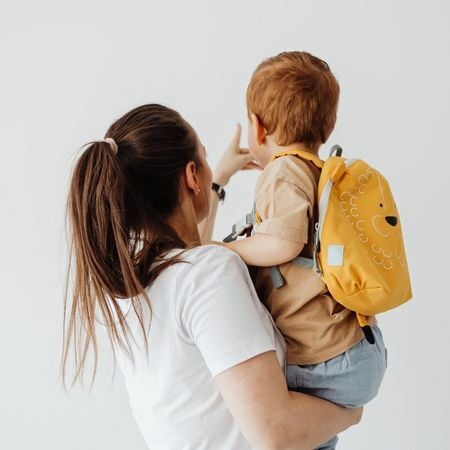 When it comes to starting a new school or early learning program, many toddlers may experience separation anxiety.
Separation anxiety is when a child becomes upset when separated from a parent or caregiver. While it commonly begins during infancy, children may experience separation anxiety at different ages and stages of development, particularly during periods of transition.
Carmen Estrada, an Education Supervisor at Options for Learning, explained that if your child cries at drop-off or when you leave home, it doesn’t necessarily mean they dislike school or are unhappy. Instead, they may be adjusting to a new environment and learning to feel safe and comfortable away from their parent or caregiver.
“It’s okay if they cry because it’s something that they need to get used to,” Carmen explained. “In the beginning, it’s harder sometimes for the parents when they see that. But it doesn’t mean that the child doesn’t like the school or the environment. It just means that it’s something different for them.”
Carmen added that children often become more confident as they build relationships, establish routines, and feel safe in their environment.
4. Difficulty with sharing
You may be familiar with the phrase “sharing is caring,” but it can be difficult for children to grasp its importance at a young age. Sharing is a skill that develops over time and often requires practice, modeling, and guidance from adults.
For instance, 24-month-olds have been shown to share frequently and spontaneously, whereas 18-month-olds shared only when given multiple opportunities and when the caregiver provided sufficient communicative support.
While learning to share comes with time, early learning programs, such as preschools, can provide a strong foundation for children to begin building these skills at a young age.
“Sharing is guided by the teacher, but it’s really the children trying to problem solve,” Carmen Estrada said. “We want the children to gain that independence and resolve conflicts on their own, and to be able to use their words.”
Preschool programs, like those at Options for Learning, practice sharing by guiding turn-taking, encouraging problem-solving, and supporting children as they learn to use words to express their needs.
There are also ways to practice sharing at home, including caregivers modeling taking turns, using simple phrases such as “Can I have a turn when you’re done?”, and praising cooperative behavior.
5. Short attention spans

Since your child’s brain is still developing when they’re a toddler, it’s normal for them to have trouble concentrating for long periods of time.
On average, a 2-year-old’s attention span lasts from 4-6 minutes, while a 3-year-old’s attention span lasts from 6-8 minutes.
As children grow and develop, they are often able to focus for longer periods, particularly when activities are engaging and match their interests.
“Doing things that really pique their interest and capture their attention, they’re really going to learn more,” Monica Velasquez, a preschool teacher at Options for Learning, said.
Signs your child may need extra support
Although it is common for toddlers to have tantrums or struggle with separation anxiety, you may still wonder when it might be time to ask additional questions or seek support.
It is important to consider a child’s age, the frequency of the behavior, and whether multiple concerns are occurring simultaneously.
For example, occasional tantrums are expected for a 2- or 3-year-old. However, if behaviors become more frequent or more intense, or begin to affect a child’s ability to participate in daily activities and relationships, it may be helpful to speak with a pediatrician or another trusted professional.
Parents may also want to pay attention to:
-
Significant changes in a child’s personality or behavior
-
Regressive behaviors, such as returning to skills they had previously mastered
-
Difficulty interacting with peers or adults
-
Aggressive or withdrawn behaviors
-
Concerns raised by teachers, caregivers, or healthcare providers
-
Behaviors that continue despite consistent support and intervention
Keep in mind that seeking support is not about labeling a child or assuming something is wrong, but instead, understanding a child’s needs and ensuring they have the resources and support they need to thrive.
Still concerned about whether your child’s behavior is normal?
 If you are still concerned about your child’s development, behavior, or ability to interact with others, reach out to your child’s teacher, pediatrician, or another trusted professional.
The Behavioral Health team at Options for Learning is available to provide guidance, resources, and support to families with questions about their child’s social-emotional development and behavior.
If you are interested in learning more about what Options for Learning has to offer, connect with one of our educational advisors to explore your options and see all the resources available to you. We’re here to support your family every step of the way.
Frequently asked questions
Is it normal for toddlers to have tantrums every day?
Many toddlers experience frequent tantrums as they learn to manage big emotions, communicate their needs, and become more independent. While tantrums can be challenging, they are often a typical part of development during the toddler years.
Should I be worried if my child bites, hits, or pushes other children?
 These behaviors can be common in young children, especially when they are still developing language and self-regulation skills. However, if the behaviors become more frequent or more intense, or persist as your child gets older, it may be helpful to speak with your child’s teacher, pediatrician, or another trusted professional.
Is it okay to ask for help if I’m concerned about my child’s behavior?
Absolutely. Seeking guidance is not about labeling a child or assuming something is wrong. Asking questions can help families better understand what is developmentally appropriate and connect them with resources or strategies to support their child’s growth.
