Before taking steps to enroll their children in a transitional kindergarten program, parents want to know how it will benefit their children – and how it differs from preschool.
Transitional kindergarten – commonly referred to as TK – is an early entry point into the public school system for 4-year-olds where children are introduced to school routines, learning environments, and early academic concepts.
Preschool is an early childhood care and learning setting for young children that is often viewed as a more flexible, play-based environment focused on care, socialization, and foundational development.
From early literacy concepts to social-emotional growth, TK introduces children to a wide range of foundational skills. In this article, we’ll cover:
Early academic skills
%20Inline%20Photo%201.jpg?width=443&height=443&name=What%20Will%20My%20Child%20Learn%20in%20Transitional%20Kindergarten%20(TK)%20Inline%20Photo%201.jpg)
Unlike preschool, TK programs are heavily focused on academics, including literacy skills and mathematics.
Many people assume that TK is just a “place to go play.” However, educators are working hard to break that down that myth and show that we do so much more than that.
There is a strong caring component in TK programs, but the teachers are not just babysitters. Children are gaining valuable knowledge, which will ultimately help them on their journey to kindergarten.
Literacy skills
One key skill that children in TK programs work on is literacy. According to the California Department of Education, TK programs focus on core literacy areas: language, foundational integrated reading and writing skills, and comprehensive ELD (a program for English learners to develop listening, speaking, reading, and writing skills).
1. Language
Since language is the primary means by which humans communicate, it is very important that children have daily opportunities to speak with adults and one another. Furthermore, children also need to develop the ability to interact with texts as speakers, listeners, readers, and writers.
TK programs often support language development through evidence-based practices. One example is using open-ended prompts, such as asking, “Why do you think that happened?” rather than single-answer questions. Teachers may also read aloud daily, introduce new vocabulary, and use visual supports like pictures and graphs to reinforce learning.
2. Foundational integrated reading and writing
Foundational literacy skills are essential in early childhood education. It is important to make sure that children can identify printed words in texts and translate oral language into written language.
Learning print concepts, phonics activities, and reading practices should be implemented in every TK program.
Additionally, some evidence-based practices to help children comprehend text include interactive read-alouds, reading the same books several times over a few days, and using questions and prompts to develop children’s overall understanding of story details.
3. Comprehensive ELD
TK programs often include ELD, which refers to programs that develop English proficiency for both multilingual learners and English learners.
Some ways to incorporate ELD lessons into the classroom include examining and identifying unfamiliar language for children, analyzing the structure of a reading, highlighting cross-linguistic connections, and providing flexible pacing to accommodate children’s processing time in English.
Mathematic skills
Aside from literacy skills, TK programs also focus on early math skills, including sequencing, shapes, measurement, and one-to-one correspondence, otherwise known as the ability to recite numbers.
“Mathematics learning at this level must be active, rich in natural and mathematical language, and filled with thought-provoking opportunities,” according to the NCTM Principles and Standards for School Mathematics. “Students respond to the challenge of high expectations, and mathematics should be taught for understanding rather than around preconceptions about children’s limitations.”
Through hands-on exploration, real-world examples, and play-based activities, children have opportunities to learn math through structured sequences that spark curiosity and foster conversation.
Incorporating play-based learning
%20Inline%20Photo%202.jpg?width=450&height=450&name=What%20Will%20My%20Child%20Learn%20in%20Transitional%20Kindergarten%20(TK)%20Inline%20Photo%202.jpg)
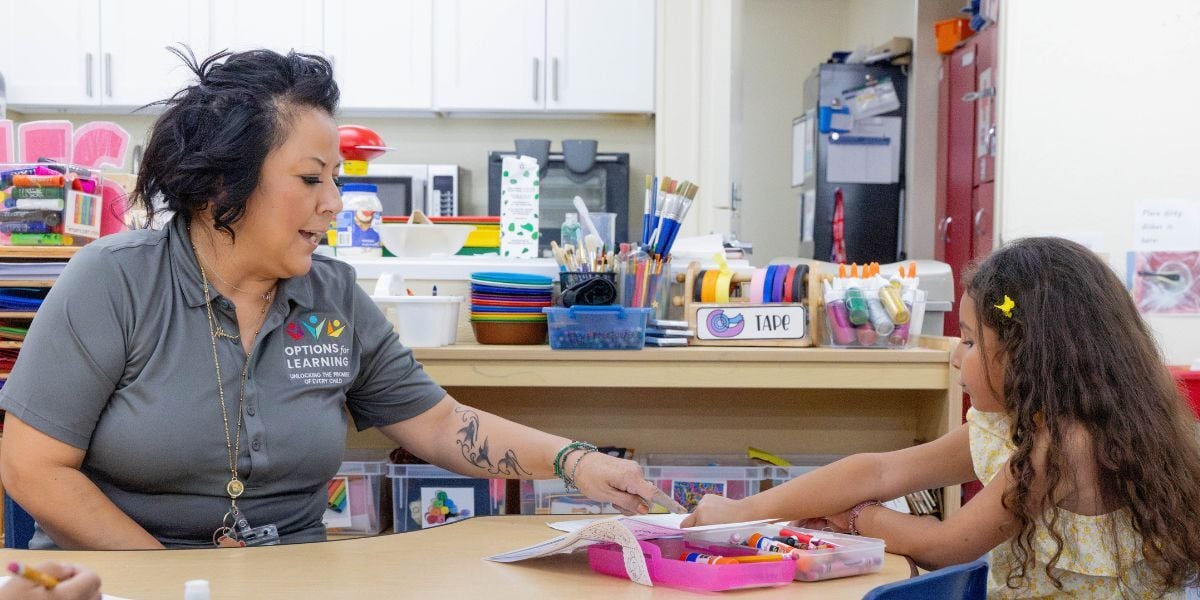
TK has commonly incorporated a play-based learning structure to help children grasp literary and mathematical concepts.
Per the National Association for the Education of Young Children, play-based learning emphasizes that children can learn content while playing freely, with teacher guidance to maximize individual learning goals.
Throughout my more than 20 years as an educator, I’ve witnessed how a play-based learning environment fosters natural socialization and curiosity about the world.
One element that has emerged from this type of structure is project-based learning, which focuses on solving real-world problems.
Project-based learning is based on exploration and a child’s own discovery. Children are encouraged to pursue their own interests with the teacher’s guidance. For example, a class that becomes interested in plants might spend several weeks planting seeds, observing growth, measuring their plants, and discussing what plants need to survive.
Throughout TK, there is a balance between play-based learning and academic content to drive the play.
Some examples of play-based learning are painting or working with clay to develop creativity and fine motor skills, using blocks to create towers to develop problem-solving skills, acting out real-life situations, such as playing “house” to develop social skills and language development, and playing rhyming or sound-based games to develop early literacy skills.
Social and emotional development
%20Inline%20Photo%203.jpg?width=450&height=450&name=What%20Will%20My%20Child%20Learn%20in%20Transitional%20Kindergarten%20(TK)%20Inline%20Photo%203.jpg)
Aside from learning several academic skills, children in TK programs are equipped with the tools to thrive socially and emotionally.
Children begin learning how to interact with others, build relationships, and navigate group settings. This includes practicing skills like sharing, taking turns, and understanding appropriate behavior.
Through play and guided interactions, children also develop independence, confidence, and the ability to express their emotions. Supportive and responsive educators help create an environment where children feel safe exploring and learning at their own pace.
“Children interacting and learning in environments where they can explore and practice the skills that they’re developing are the biggest benefits,” shares Cynthia Rodriguez, program supervisor in the Resource and Referral Department at Options for Learning.
In a survey conducted by the Stanford Center on Early Childhood in 2024, 81% of California families shared that a TK program supports their child’s social-emotional learning.
Additionally, the TK California website reported that current research identifies self-regulation of emotions and behavior as one of the strongest predictors of academic success and as a key driver of success in the workplace, social settings, and life for all young school-aged children.
What Options for Learning’s support for TK-age children looks like
%20Inline%20Photo%204.jpg?width=450&height=450&name=What%20Will%20My%20Child%20Learn%20in%20Transitional%20Kindergarten%20(TK)%20Inline%20Photo%204.jpg)
All TK programs look different, and Options for Learning has unique transitional kindergarten programming for 4- and 5-year-olds.
Our program offers:
-
Full-day instruction, play, and enrichment
-
Small class sizes and individual attention
-
Age-appropriate care throughout the day
-
Year-round availability
-
Kindergarten readiness alignment
-
Support for growing independence
-
Nutritious meals and snacks at no cost
-
Family partnership and support
All of these qualities are meant to support kids with a smooth, confident transition into kindergarten.
If you are interested in learning more about Options for Learning’s support for TK-age children, complete this interest form, and one of our educational advisors will be in touch shortly.
Final thoughts on TK learning
%20Inline%20Photo%205.jpg?width=450&height=450&name=What%20Will%20My%20Child%20Learn%20in%20Transitional%20Kindergarten%20(TK)%20Inline%20Photo%205.jpg)
Aside from introducing children to early academic concepts like literacy and math, TK’s true value lies in providing a school environment where they can explore, interact with others, and begin building confidence.
Parents should look for a program that supports their child’s learning in a way that feels natural and engaging. Whether through structured activities or play-based learning, the goal of TK is to meet children where they are and help them take their first steps into school with confidence.
Ready to take the next step? Learn more about Options for Learning’s support for TK-age children.
