
Watching your child grow and develop their own personality and traits is one of life’s greatest joys. However, wondering if your child is reaching their developmental milestones on time can also be stressful.
Developmental milestones are skills or behaviors that most children reach at a certain age, such as speaking, pointing at things, or taking their first steps.
While these milestones serve as a helpful guide, it’s important to remember that every child learns and develops at their own pace.
However, if you have any specific concerns, it is always okay to ask questions and seek support.
Options for Learning’s Behavior Health and Inclusion team continues to work individually with families whose children have developmental diagnoses or concerns to support children’s physical, emotional, cognitive, and social development.
For over 45 years, Options for Learning has provided 11,000 children and families annually in the San Gabriel Valley with affordable, high-quality early learning programs and educational resources.
Read on to learn about:
-
What the four areas of development are
Quick Answer: Developmental milestones help families track how children grow and learn over time. Most milestones fall into four areas of development: social-emotional development, language and communication, cognitive development, and movement and physical development.
What are the four areas of developmental milestones?
Developmental milestones can help families better understand how children learn, grow, and develop over time.
According to the Centers for Disease Control and Prevention (CDC) and the American Academy of Pediatrics (AAP), the developmental milestones reflect what about 75% of children can do by a given age.
Developmental milestones usually fall into four categories:
-
Social and emotional
-
Language and communication
-
Cognitive
-
Movement and physical development
Social and emotional
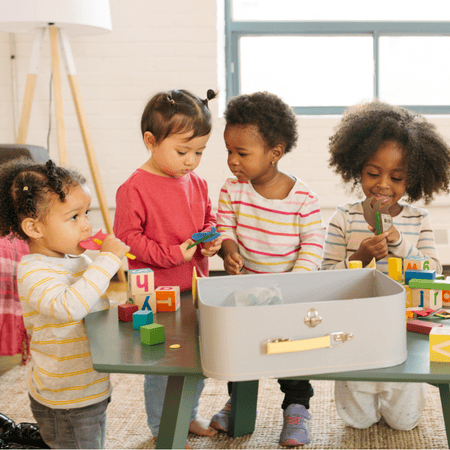 The first domain, social and emotional development, focuses on how children interact with others, build relationships, and express their emotions.
As children grow, they learn to communicate through needs, form connections with family and friends, manage emotions, and navigate social situations.
Language and communication
The second domain, language and communication, focuses on how children understand language and express their thoughts, needs, and ideas.
As children grow, they learn to communicate through sounds, gestures, words, and conversations, helping them build relationships and explore the world around them.
Cognitive
 The third domain, cognitive, refers to how children learn new things and solve problems.
This category includes understanding how children explore their environment to figure things out, as well as academic skills like counting and learning letters.
Movement and physical development
The fourth category, movement and physical development, explores your child’s use of gross and fine motor skills.
Gross motor skills use larger muscles and muscle groups, and can include things like rolling, crawling, and walking. Meanwhile, fine motor skills involve the smaller muscles in the hand and wrist, such as those involved in grasping and hand-eye coordination.
What are the different developmental milestones by age?
| Age range | Social and emotional | Language and communication | Cognitive | Movement and physical development |
| Birth to 12 months | • Smiles when you talk or smile at them • Looks at familiar people • Responds to their name • Plays simple games like peek-a-boo • Shows different facial expressions |
• Makes sounds other than crying • Responds to voices and sounds • Babbles and copies sounds • Waves goodbye • Understands simple words such as “no” |
• Watches people and objects • Puts objects in their mouth to explore • Looks for hidden objects • Reaches for toys • Places objects into containers |
• Holds head up steadily • Rolls over • Sits without support • Pulls up to stand • Uses fingers to pick up small objects |
| 15 months to 3 years | • Shows affection through hugs, cuddles, or kisses • Notices when others are hurt or upset • Looks to trusted adults in new situations • Begins playing with other children • Calms down after separation |
• Tries to say new words • Points to things in books when asked • Combines two or more words together • Asks simple questions • Participates in back-and-forth conversations |
• Uses everyday objects appropriately • Engages in pretend play • Copies chores and activities • Shows simple problem-solving skills • Draws simple shapes |
•Walks without help • Runs and climbs • Kicks a ball • Feeds themselves with utensils • Turns book pages and scribbles |
| 4 to 5 years | • Plays cooperatively with other children • Comforts others who are upset • Takes turns and follows rules during games • Completes simple chores • Adapts behavior to different settings |
• Speaks in complete sentences • Tells simple stories • Answers and asks questions • Carries on conversations • Recognizes simple rhymes |
• Names colors and some numbers • Counts to 10 •Understands simple concepts of time • Pays attention during activities • Recognizes or writes some letters |
• Catches a large ball • Uses crayons and pencils with control • Serves themselves food with supervision • Buttons and unbuttons simple clothing • Hops on one foot |
When should you seek extra support?
 It can be difficult to notice when your child is struggling at home, which is why teachers and caregivers are often on alert for signs that a child may need early intervention.
Some signs that a child may benefit from additional support include:
-
Struggling to interact with other children in an age-appropriate way (e.g., sharing materials, being able to be aware of their surroundings with others)
-
Trouble with verbal or nonverbal communication (if they are unable to share their needs)
-
Delay in developing motor and self-help skills (e.g., being able to feed themselves)
-
Vision or hearing problems
-
Poor attention span
If you notice any of these signs in your child or have any concerns, Options for Learning’s Behavior Health and Inclusion team encourages families to reach out to their pediatrician for guidance on next steps.
Parents are often their child’s strongest advocate, and they can help by asking questions and speaking up.
The inclusion team tries to build that relationship with the parent and let them know that we’re here to support them however they need.
Some examples of questions parents can ask include:
-
Are there any areas of development that should be monitored more closely?
-
Should my child receive a developmental screening or formal evaluation?
-
What signs or behaviors should I watch for at home?
-
Could my child’s behavior be part of typical development, or should I be concerned?
-
Would my child benefit from early intervention or additional support?
-
Are there community resources, specialists, or programs you recommend?
-
When should we schedule a follow-up if concerns continue?
Every child develops at their own pace
Developmental milestones can help families understand what skills children are often learning at different ages, but every child grows and develops in their own way.
If your child isn’t meeting every milestone exactly on schedule, it doesn’t automatically mean something is wrong. However, if you have concerns about your child’s communication, movement, behavior, social interactions, or overall development, don’t be afraid to ask questions and seek support.
Now that you know what milestones to look for, your next step is to continue observing your child’s development and discuss any concerns with your pediatrician or another trusted professional. Early identification can help connect families with resources and support when needed.
If you’re interested in learning more about how Options for Learning supports children’s physical, emotional, cognitive, and social development, read this article on our Inclusion Department.
Frequently asked questions
What should I do if my child misses a developmental milestone?
Missing a milestone does not automatically mean a child has a developmental delay. However, if you have concerns about your child’s development, talk with your pediatrician or another qualified professional to discuss whether additional screening or evaluation may be helpful.
Are developmental milestones the same for every child?
 No. Children develop at their own pace. Milestones are guidelines that help families and professionals monitor a child’s growth and development over time.
Should I wait and see if my child catches up?
If you have concerns, it’s often best to ask questions sooner rather than later. Early identification and support can help children access services and resources when needed.