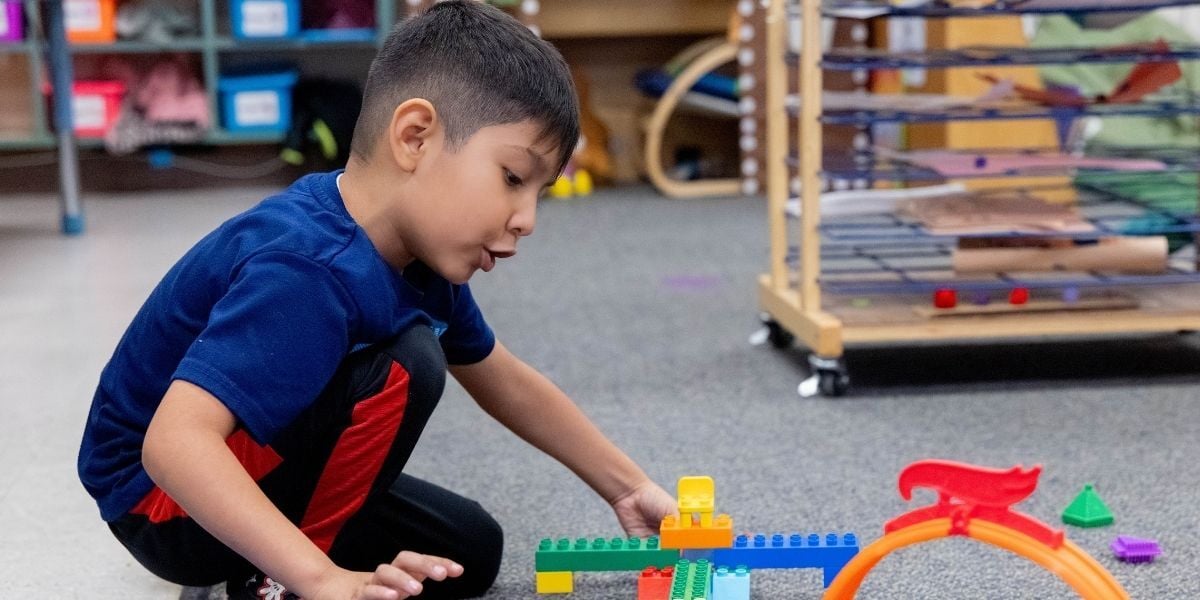
Whether it’s building a tower of blocks or playing dress-up, children love to play!
Play is actually more than just fun. Play helps children build important learning concepts, as well as social-emotional, cognitive, and motor skills.
Since play is a natural part of early childhood, incorporating it into the classroom helps children develop foundational academic skills, including early literacy and math concepts.
For 45 years, Options for Learning has used a play-based learning approach in its early learning programs to help teachers connect with children and meet them where they are at.
Keep reading on to learn more about the importance of play-based learning, including:
-
Benefits of play-based learning
-
The difference between guided and unguided play-based learning
Understanding play-based learning
 If you have been looking at different toddler or child care options, you may have come across the term “play-based learning” and wondered if that meant your child would simply be playing for several hours a day. However, a play-based learning curriculum is more elaborate than it may seem at first glance.
The idea of play-based learning has been around for over 180 years, with the concept introduced by German educator Friedrich Froebel in the 1840s.
Froebel, who opened the first kindergarten in 1836 for children under the age of 7, believed that play is the principal means of learning in early childhood.
“The child is free to determine his own actions according to the laws and demands of the play he is involved in,” Froebel wrote. “Through and in his play, he is able to feel himself to be independent and autonomous.”
Froebel’s concepts gave rise to the term play-based learning, a curriculum in which children learn content while playing freely, with teacher guidance, or in structured games. This learning approach allows children to build on their natural curiosity through experimentation, exploration, and problem-solving.
“Everybody learns through play because you’re investigating materials, you’re working with things, you’re imitating, you’re using language,” Monica Velasquez, a preschool teacher at Options for Learning, explained. “It’s a process. There’s no right or wrong. You’re not going to fail at it.”
Monica noted that in a play-based learning environment, children not only learn about the world around them, but also “gain confidence in a fun, curious way.”
Benefits of play-based learning
Through the play-based learning curriculum, children are learning and building important skills that they will take with them throughout the rest of their lives.
The goal is not for children to spend most of their day completing worksheets or listening to lectures. If they are actively engaged and teachers are responsive to their interests, research has shown that children are more likely to develop academic, cognitive, motor, and social-emotional skills earlier in life.
Academic skills
Hands-on learning positively affects the acquisition of skills such as math, shape knowledge, and task switching compared with more traditional approaches that prioritize lectures and explicit instruction.
In fact, in another study that same year, guided play was shown to be more effective than direct instruction for teaching academic content to children under eight.
As a result, play-based learning can help children build key academic skills, including:
-
Language and communication development (creating new conversations in pretend play, using games, songs, and stories to learn phonics and increase vocabulary, etc.)
-
Math (puzzles and games to learn concepts such as counting, addition, subtraction, measurement, etc.)
-
Science (hands-on experiments, observations where children learn about cause and effect, classification, and observation)
-
Social studies (role-playing, simulations, and cultural activities to help children learn about geography, history, and culture)
Social-emotional skills
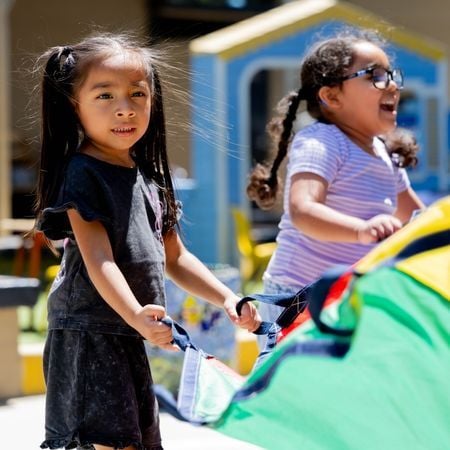 In addition to academic growth, hands-on learning supports children’s social-emotional growth.
Letting children play significantly enhances problem-solving and divergent thinking skills.
Meanwhile, integrating play-based learning into early childhood education can significantly enhance resilience and social-emotional well-being in children exposed to adversity.
For example, while caring for a doll or comforting a friend during dramatic pretend play, children are building empathy and cooperation skills.
Social-emotional skills include:
-
Self-regulation (managing big emotions, waiting their turn, following simple rules)
-
Emotional awareness (identifying feelings, recognizing emotions in others)
-
Empathy (noticing how others feel, understanding different viewpoints)
-
Cooperation (working toward a shared goal, sharing materials, taking turns)
Cognitive skills
Play-based learning has also proven beneficial in developing children’s cognitive skills. Cognitive skills are the mental processes that allow us to acquire, process, store, and use information. These skills help children navigate the world around them and make sense of their experiences.
Various types of play contribute differently to cognitive skill development. For example, guided play enhances cognitive functions such as language acquisition, problem-solving, and executive functions.
Some key cognitive skills include:
-
Critical thinking (learning to ask questions, think through challenges, make predictions)
-
Problem-solving (identifying problems, learning from mistakes, persistence)
-
Memory (recall of information and experiences)
-
Attention and focus (concentrating on tasks, following directions, filtering out distractions)
Motor skills
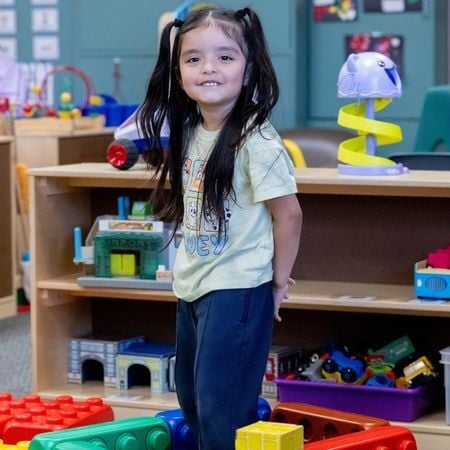 Motor skills are the voluntary muscle movements that the body uses to perform specific physical actions and tasks. They are usually divided into two categories: gross motor skills (large movements such as crawling, walking, running, and raising arms) and fine motor skills (smaller movements such as holding a pencil, zipping, and using scissors).
Through play-based learning, children have opportunities to strengthen their balance, coordination, fine motor skills, and overall physical development.
Child-directed play vs. teacher-directed play
In a play-based learning curriculum, activities are usually divided into two categories: child-directed play and teacher-directed play.
Child-directed play
Child-directed play, otherwise known as free or unstructured play, is when children choose what they want to play with and how they want to engage with an activity, either independently or with other children in the classroom.
With this type of play, children have full control over what they want to play with and how they want to do it, which gives them time to explore their own interests and ideas.
While children lead the experience, teachers still play an important role in supporting learning. Teachers observe how children interact with materials, ask questions that encourage thinking, and provide opportunities that extend children’s interests and exploration.
One example of child-directed play is when children are playing with blocks and building towers, either alone or with other students.
While this activity may appear to be simple play, children are actually exploring early architecture concepts, cause and effect, problem-solving, and social relationships.
Other examples of free play in the classroom are:
-
Pretending to run a grocery store, restaurant, etc.
-
Playing family roles such as a parent or pet
-
Creating imaginary scenarios with costumes and props
-
Drawing, painting, or coloring freely
-
Exploring playdough or sculpting materials without instruction
-
Digging and pouring in a sand table
-
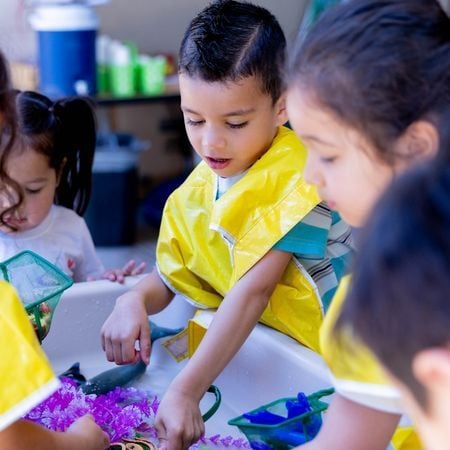
Exploring water with cups, funnels, and toys
-
Looking through books independently
-
Exploring musical instruments
Teacher-directed play
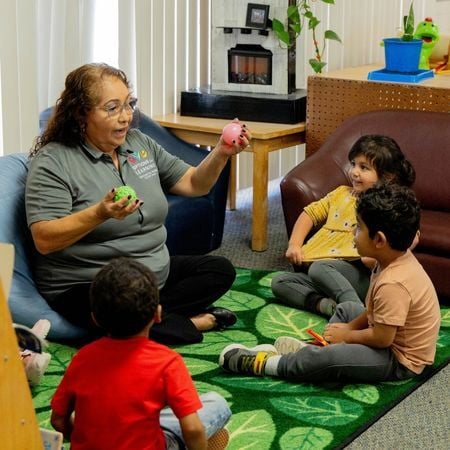 Teacher-directed play, also known as guided or structured play, typically refers to play activities in which educators intentionally guide learning opportunities while keeping children actively engaged.
Some activities involve the teacher joining in, while others allow the teacher to serve as a facilitator, guiding learning through questions, discussion, and explanation.
There are several examples of teacher-directed play, including:
-
Acting out a story with puppets
-
Going on a letter hunt around the classroom
-
Matching pictures to beginning letter sounds
-
Helping build towers with children and comparing which is taller or shorter
-
Observing insects with magnifying glasses
-
Making a pretend grocery store with shopping lists and play money
-
Making up movement patterns for classmates to follow
Teachers often use observations from child-directed and teacher-directed activities to plan future learning experiences that build on children’s interests and developmental needs.
Interested in learning more about play-based learning?
Options for Learning believes that children learn best through play, exploration, and positive caregiver interactions.
If you are interested in learning more about the benefits of a play-based learning curriculum for your child, connect with one of our educational advisors to explore all of the options that would be the best fit for your family.
Frequently asked questions
Does play-based learning prepare children for kindergarten?
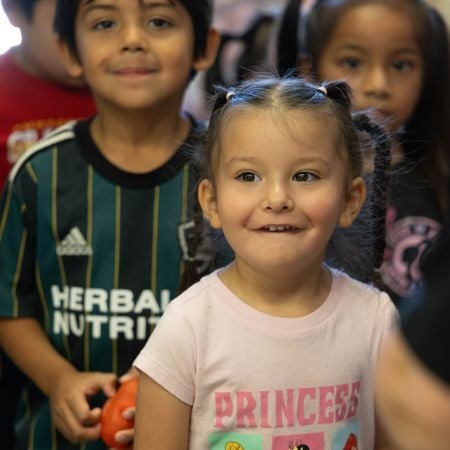 Yes. Through play, children build many of the skills that support kindergarten success, including communication, problem-solving, self-regulation, cooperation, and early literacy and math concepts.
Why do teachers spend time observing children play?
Observation helps teachers better understand each child’s interests, strengths, and developmental needs. Teachers can then use that information to plan meaningful learning experiences that build on what children are already curious about.
Can children learn different skills from the same activity?
 Absolutely. A single activity can support multiple areas of development at once. For example, while building with blocks, children may practice problem-solving, communication, cooperation, creativity, and fine motor skills.
